
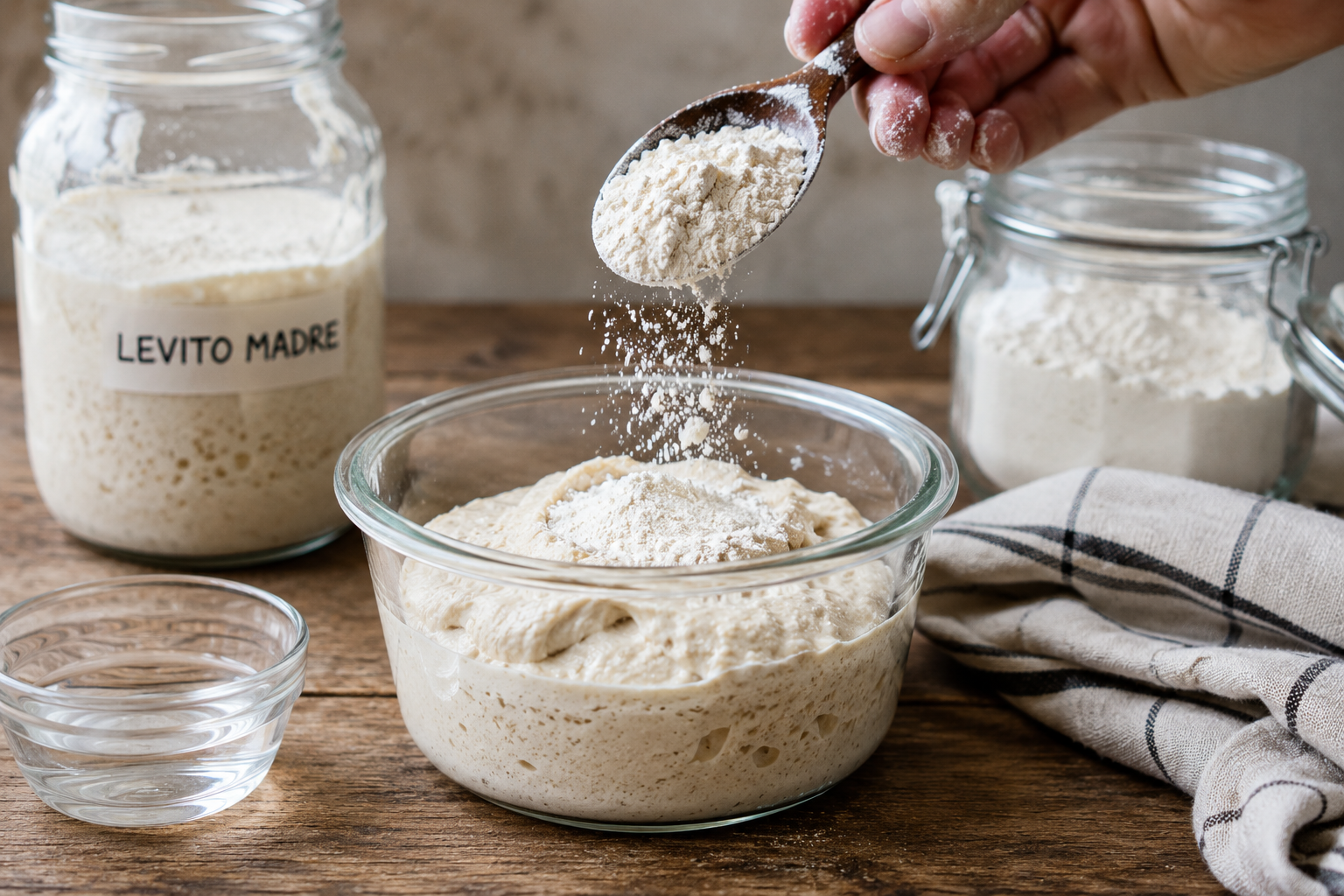
Levito Madre requires regular feedings to remain healthy, active, and ready for baking.
A consistent feeding schedule helps maintain strong fermentation and prevents the starter from becoming weak or overly acidic.
With proper care, Levito Madre can stay active for many years and provide excellent baking results.
Why Feeding Is Important
The wild yeast and beneficial bacteria inside Levito Madre need fresh flour and water to survive.
Without regular feedings, the microorganisms gradually lose activity.
As a result, the starter may rise more slowly and become less effective for baking.
Regular refreshments keep the culture balanced and healthy.
Basic Feeding Ratio
Many bakers use a simple feeding ratio when refreshing Levito Madre.
A common method is to combine mature Levito Madre with fresh flour and water.
The ingredients are mixed and kneaded until a firm dough forms.
The exact ratio may vary depending on temperature, flour type, and baking schedule.
How to Feed Levito Madre Step by Step
Remove the amount of starter needed for feeding.
Add fresh flour and water.
Mix the ingredients thoroughly.
Knead until the dough becomes smooth and elastic.
Shape the dough into a ball.
Place it in a clean container.
Allow it to ferment at room temperature.
Levito Madre: Complete Guide to Italian Sourdough Starter
What Is Levito Madre? Complete Beginner's Guide
How to Create Levito Madre From Scratch
How Often Should You Feed Levito Madre?
The feeding schedule depends on how frequently you bake.
If Levito Madre is kept at room temperature, daily feedings are usually recommended.
If it is stored in the refrigerator, feeding once every few days may be sufficient.
Many bakers refresh the starter before baking to ensure maximum activity.
Signs of a Healthy Levito Madre
A healthy Levito Madre should increase noticeably in volume after feeding.
The texture should become light and airy.
Small air pockets should be visible throughout the dough.
The aroma should be pleasant and slightly sweet.
These signs indicate strong fermentation activity.
Common Feeding Mistakes
One common mistake is feeding too infrequently.
Long periods without fresh flour and water can weaken the starter.
Another mistake is using water that is too hot, which may damage the microorganisms.
Keeping the starter in a very cold environment can also slow fermentation significantly.
Consistent care usually prevents most feeding problems.
When to Feed Before Baking
Many bakers feed Levito Madre several hours before mixing dough.
This allows the starter to reach peak activity.
Using an active starter can improve dough rise, crumb structure, and overall baking performance.
For best results, bake when the starter is strong, expanded, and full of fermentation activity.
Regular feeding is the key to maintaining a healthy Levito Madre.
A well-fed starter develops strong fermentation power, a pleasant aroma, and reliable baking performance.
With a simple feeding routine, Levito Madre can remain active and productive for many years.